

In modern-day society, it is impossible to navigate a day without using AI. From simply looking up questions on the internet to driving using apps like Google Maps and Waze, AI is everywhere.
Most people would agree that AI is an overall positive addition to the technological world. However, these machines, which are constantly being created, trained, used, and disposed of, are not perfect and have harmful effects of gigantic proportions.
One of the most pressing issues related to AI use is its environmental impact. Behind the magnificent innovations that AI has influenced lies enormous amounts of energy expenditure and, subsequently, an even larger carbon footprint.
AI models are present in most technological devices: smartphones, smartwatches, and computers, using relatively small data centers to operate these models.
But, with the rise in popularity of models like OpenAI’s Generative AI, larger data centers must be built, scaling up from 100,000 square feet to one to two million square feet. To build these centers, large plots of land must be cleared, destroying the habitats of numerous species and decreasing the area’s biodiversity in the process.
AI’s energy expenditure starts before even being released into the public. These machines are not created knowing everything; they need to be trained. According to OpenAI researchers, since 2012, the amount of computing power required to train state-of-the-art AI models has doubled every 3.4 months.
AI training relies on inner systems known as “deep learning” models to function. “Deep learning” consists of a system based on neural networks made up of multiple layers, simulating the thought process of the human brain. These models are extremely computer-intensive, spending great amounts of energy just in this primary process. 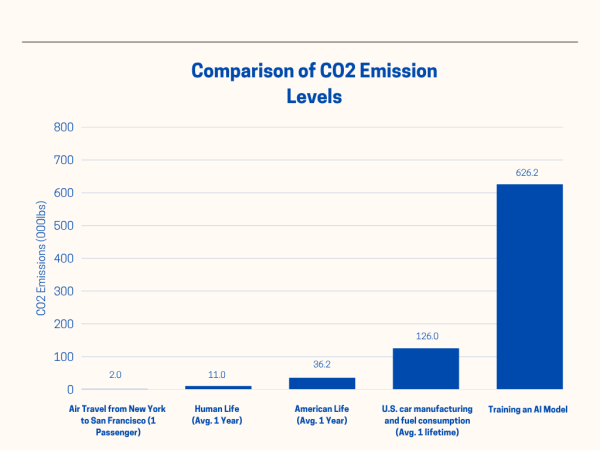
Larger centers for larger AI models require enormous amounts of energy in order to operate through machine learning and deep learning. According to the International Energy Agency (IEA), AI data centers’ electricity consumption in 2026 will be double that of 2022; 1,000 terawatt-hours. This is roughly the equivalent of Japan’s current total consumption.
Still, it is important to note that these data centers, though primarily used for AI operation, are also responsible for the management of the computational aspects of companies like Gmail, Amazon, and Bitcoin are also managed in these data centers.
According to research conducted at MIT to determine energy usage in training large AI models, training can produce about 626,000 pounds of carbon dioxide—the equivalent of around 300 round-trip flights between New York and San Francisco or nearly five times the lifetime emissions of the average car.
“They found that the computational and environmental costs of training grew proportionally to model size and then exploded when additional tuning steps were used to increase the model’s final accuracy,” the article stated.
Another problem that arises from AI operations is cooling. To cool sensitive electronic systems, water free of contaminants like bacteria, VOCs and man-made waste must be used. This means that AI centers often employ the use of the same water people consume for drinking, cleaning, and cooking.
For example, a study on AI water expenditure by Shaolei Ren found that training the GPT-3 language model in Microsoft’s U.S. data centers can “directly evaporate 700,000 liters of clean freshwater. More critically, the global AI demand is projected to account for 4.2 to 6.6 billion cubic meters of water withdrawal in 2027, which is more than the total annual water withdrawal of Denmark or half of the United Kingdom.”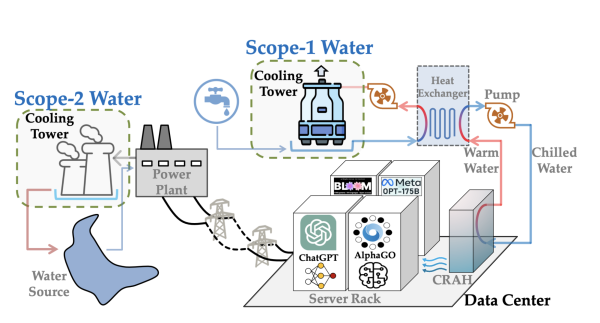
Considering all of the aforementioned evidence, it is clear that AI’s very nature leads to environmental damage.
Still, there is hope. Because generative AI’s very nature is problem resolution and idea creation, when used ethically and correctly, AI can actually help solve environmental issues.
In order to allow AI to reach its potential as a positive influence in climate issues, AI companies must be transparent with their energy and water expenditure rates as well as their carbon emission rates. By doing so, adequate legislation can be made based on these emissions to set limits and standards on AI companies.
AI companies must also reduce energy expenditures caused by deep learning and machine learning processes, which greatly increase AI’s energy consumption. AI centers must make sure their machinery can withstand the high rates of energy consumption by using better materials that will make data processing and training more efficient and less costly.
“A responsible approach to AI that prioritises sustainability will be made possible by working toward greater accountability,” explains Alokya Kanugo for Earth.org.
Once AI’s carbon emissions and energy and water expenditures are reduced and under control, its services could be used for a variety of environmentally friendly applications.
AI can be used to find more efficient uses of energy in society, such as constructing more energy-efficient buildings.
AI could also help to design better materials for solar panels, creating low-carbon materials, as well as better monitoring of deforestation and greener transportation. The correct use of AI can even assist in the employment of fossil-free energy and make energy supplies more efficient.
Ultimately, AI can be a beneficial tool that serves humanity while simultaneously protecting our planet. But it is up to the joint efforts of governments, companies and all individuals to create a responsible and conscious culture that prioritizes environmental well-being when employing the use of AI.